The slide behind this article makes a claim that is easy to skim past: uncertainty is the enemy of confidence. In cosmetic dentistry, uncertainty has a specific shape. It is the gap between the smile you can picture and the smile a clinician is describing in words. Step 2 of the 2026 Digital Smile Roadmap exists to close that gap before any irreversible step is taken. If you are here looking into cosmetic smile makeover, the sections below walk through the process from the first quote to the finished job.
The problem with approving a description
Language is a poor medium for teeth. When a clinician says the result will be "brighter but natural," your mind supplies a shade. When they say "balanced and proportionate," your mind supplies a shape. Those private pictures rarely match the clinician's, and nothing reveals the mismatch until the work is on your teeth. At that point the options are acceptance, adjustment, or starting over — all three more expensive than having looked at the same picture together at the start.
What the 90-second confirmation actually does
From a single photograph, you preview your exact aesthetic outcome in minutes. The deck's own number is ninety seconds, and the point of the number is not speed for its own sake. It is that visual confirmation does not need to be a separate appointment or a special event. It is fast enough to be part of the ordinary conversation, which means it can happen while you are still deciding rather than after you have decided.
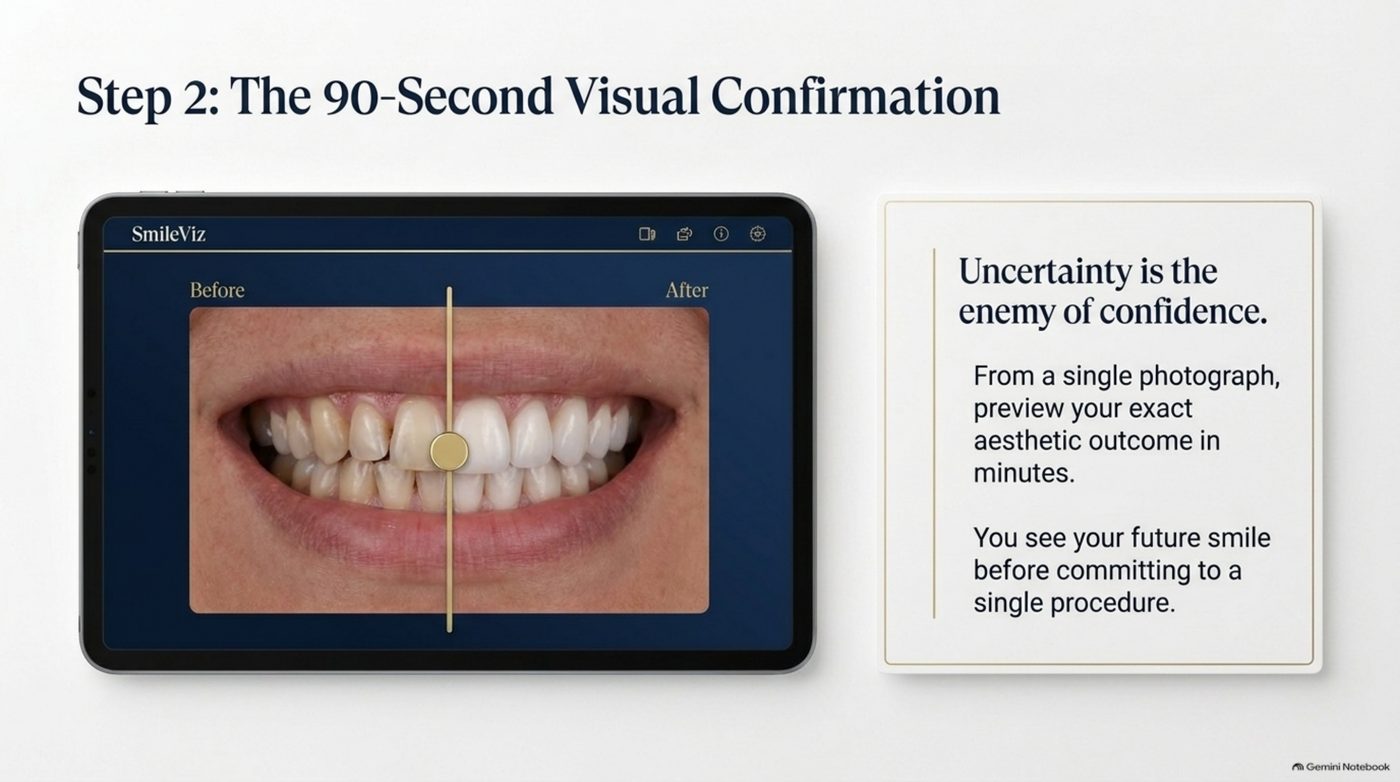
Before and after, side by side
| Decision point | Without visual confirmation | With a 90-second preview |
|---|---|---|
| What you are approving | A verbal description | A specific, simulated outcome |
| When you find the mismatch | After the work is done | Before any procedure is committed to |
| Time cost of the preview | Not available | Minutes, from a single photograph |
| Effect on confidence | Hope that it matches | You see your future smile before committing to a single procedure |
| Room for adjustment | Rework against a fixed result | Direction changes while it is still free to change |
Why seeing it changes the conversation
Once a simulated outcome is on screen, patients stop asking "will it look natural?" and start asking specific, answerable questions. Is the midline where I want it? Is that incisal edge too long? Can we soften the transition here? Those are questions a plan can act on, and answering them costs nothing at this stage. The same questions asked after delivery are expensive.
There is a second effect that matters just as much: the preview protects you from over-promising. A simulation is bound by your anatomy, your enamel and your bite. When you can see what your own starting point supports, expectations are calibrated by evidence rather than by a photograph of someone else's teeth.
How to get the most from your preview
Bring a photograph you like and a photograph you do not, and be ready to say which parts of each you are reacting to. If you are not sure what you want to change yet, work through the smile quiz first — it turns a general wish into a list. The knowledge quiz is a useful second step for separating things you have read from things that are true of your case. Everything free is collected on the tools hub.
To preview your own outcome, start with a photograph and a conversation. Call (605) 601-8245 and ask what a visual confirmation would show for your smile.
What the preview is not
A visual confirmation is not a photograph of a finished result, and treating it as one sets up a disappointment. It is a simulation built from your photograph and your anatomy, showing the outcome the plan is designed to reach. The materials placed at the end will be real porcelain or real composite, and the light in a treatment room is not the light in the image. What the preview gives you is direction and proportion: the shape, the midline, the length of the incisal edges, the relationship between the teeth and the lips around them. Those are the decisions worth getting right, and they are exactly the decisions a simulation can show.
Why ninety seconds is the right unit of time
Speed changes behaviour. If confirmation took a week, it would be a decision point with its own appointment, prepared for and separated from the conversation that prompted it. At ninety seconds it is part of the conversation, which means the first reaction you have is the one that shapes the plan. That reaction is usually more informative than a considered opinion formed after days of looking at an image in isolation.
Setting expectations before you look
Look at the preview as a starting position rather than a verdict. Most previews are adjusted at least once, and the adjustments are the useful part of the exercise. The question to bring is not whether the image is perfect, but which specific elements are wrong and in which direction. That is a conversation a plan can act on, and it is a conversation that costs nothing while it is still happening in simulation.
Bringing a photograph worth simulating
The preview is only as informative as the image it starts from. A clear, evenly lit photograph of your smile, taken straight on, gives a simulation far more to work with than a snapshot taken at an angle under mixed indoor light. A profile view is a useful second image if you have one. You do not need clinical equipment: a phone camera and reasonable light are enough to begin. One clear photograph is the deck's own starting point, and it is a low bar to clear for a result you can react to before committing to anything.
Frequently Asked Questions
Is a digital preview a guarantee of the final result?
It is a preview of the planned outcome, produced from your own photograph and anatomy. It exists so that you approve a specific result rather than a description, and so that any mismatch is discovered while it is still free to correct.
What if I do not like what I see?
That is the point of showing it now. Disliking a preview is cheap and instructive; disliking a finished restoration is neither. Most previews change direction at least once, and that change is the value.
Do I need a photograph in advance?
One clear photograph is enough to begin. If you have more, or a smile in profile, bring them — additional views give the simulation more to work with.