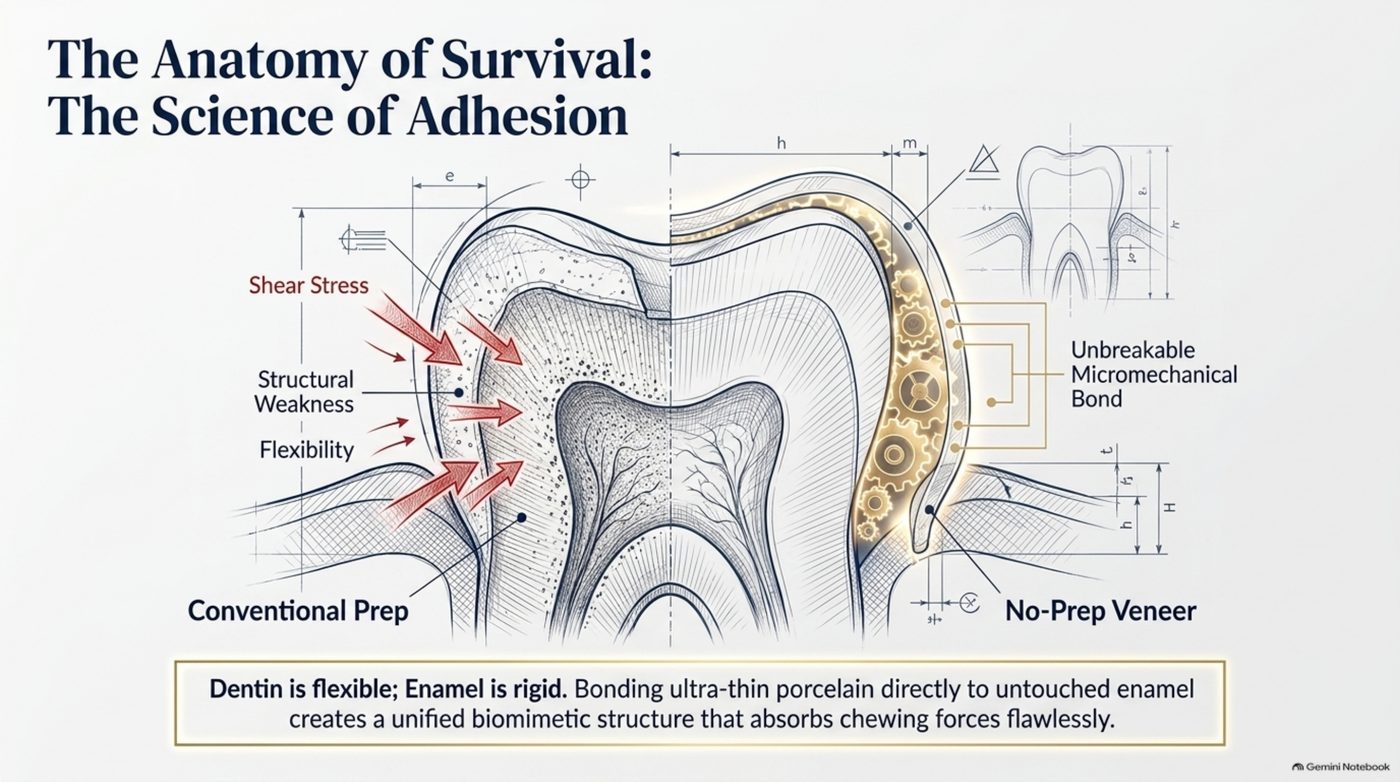
A veneer that survives for decades does so for a reason that has nothing to do with how it looks. It survives because of how it is attached. The slide behind this article describes the mechanism in a single sentence: dentin is flexible, enamel is rigid, and bonding ultra-thin porcelain directly to untouched enamel creates a unified biomimetic structure that absorbs chewing forces. Understanding why that sentence is true explains almost everything else in the 2026 Digital Smile Roadmap. Most people who read this are comparing dental bonding options around Sioux Falls, SD, so what follows sticks to the details that change in practice.
Two materials with opposite properties
A tooth is not one material. It is a rigid outer layer of enamel over a flexible inner core of dentin. This arrangement is not a design flaw; it is what allows a tooth to take load without shattering. Enamel provides the hard, wear-resistant surface. Dentin provides the give that lets the tooth deform very slightly under force instead of cracking. Any restoration plan has to work with both, and the relationship between them is where things go wrong.
What conventional preparation does to that structure
When a preparation removes the enamel, it exposes the flexible dentin directly. The restoration is then bonded to dentin, a surface that moves. A rigid restoration sitting on a moving substrate is a stress concentration waiting to happen, and the deck's label for it is structural weakness. This is the mechanical reason the conventional column in the roadmap reports catastrophic fractures: the restoration itself may be fine while the interface underneath it is working against itself.
The bond, expressed as a stress problem
| Property | Bonding to prepared dentin | Bonding to untouched enamel |
|---|---|---|
| Substrate behaviour | Flexible, moves under load | Rigid, matches the restoration |
| Restoration fit to load | Rigid piece on a moving base | Unified structure absorbs chewing forces |
| Dominant stress concern | Shear stress at the interface | Micromechanical bond distributed across the interface |
| Deck's description | Structural weakness | Unbreakable bond |
| Failure tendency | Catastrophic fracture, severe discoloration | Minor marginal chipping |
Why bonding to enamel changes the mechanical picture
Enamel is rigid, and porcelain is rigid. When ultra-thin porcelain is bonded to untouched enamel, the two rigid materials form one continuous structure rather than a rigid cap resting on a compliant base. The chewing forces arrive at a system that deforms as a single unit, which is what lets it absorb load without concentrating stress at a single line. That is the sense in which the deck calls the result a unified biomimetic structure: not a metaphor, but a description of how the assembly responds to force.
Micromechanical bonding and why it matters more than the glue
The bond in the biomimetic approach is described as micromechanical, working across the interface rather than at a few points. That distinction is what makes a very thin restoration viable. A thick piece can hide a poor interface behind bulk; an ultra-thin piece cannot, because there is nothing there to hide it. The strength has to come from the bond, which is also why the fabrication precision described in Step 4 matters so much: a sub-millimeter marginal fit is what gives that bond an intact interface to work across.
If the mechanics are unfamiliar territory, the bite force quiz is a good place to start, and the periodontal vet checklist covers the foundation the whole structure sits on. Both are free on the tools hub. To discuss what your own enamel can support, call (605) 601-8245.
Why a thin restoration needs a perfect interface
Thickness is a form of tolerance. A thick restoration distributes stress through its own body and can tolerate an imperfect interface on part of its surface. An ultra-thin restoration between 0.1mm and 0.3mm has almost no body to work with, so the interface has to carry the load directly. That is the mechanical reason the marginal fit described in Step 4 is a prerequisite rather than a detail. The bond has to be continuous across the whole junction, because there is no internal volume to absorb a localised failure.
The role of the bite in bond survival
A bond can be technically sound and still be overloaded. If the occlusion delivers force to a restoration from an unfavourable direction, the interface absorbs a stress it was not designed for, and it does so every time the patient closes. This is why health-first planning puts bite architecture ahead of veneer placement. Adjusting the architecture after the restorations are bonded means loading them in a direction their design did not anticipate, and no adhesive protocol compensates for that.
Why the mechanism explains the outcome data
The survival comparison elsewhere in this series reports a 92% average for conventionally prepared restorations against a 97% to 100% range for the no-prep approach, and the complications row reports catastrophic fractures and severe discoloration on one side against minor marginal chipping on the other. Bond mechanics explains both. A rigid restoration on a flexible substrate concentrates stress at the interface, and the failures it produces are sudden and large. A unified structure distributes stress and the failures it produces are small. The statistics are not a separate finding; they are the mechanism, measured.
Why the substrate decides the technique
Every bonding decision in cosmetic dentistry starts with a question about substrate. What is the restoration attached to, and how does that material behave under load? Enamel is rigid and bonds predictably; dentin is flexible and requires a different approach. The no-prep aesthetic works not because thin porcelain is inherently stronger than thick porcelain, but because leaving the enamel in place keeps the substrate rigid and matched to the restoration. Preserving the substrate is what makes the thin design mechanically viable, and that is the point the slide is making.
Frequently Asked Questions
Why is shear stress the limiting factor in bonding?
Because chewing applies force across the interface rather than straight into it. Shear stress is what a bond has to resist when the loading direction runs along the joint, and the material the restoration is bonded to determines how well the interface handles it.
Does the bond get stronger over time?
Bond strength is established by the interface created at placement and by the fit of the restoration. That is why the roadmap treats capture precision and marginal fit as prerequisites rather than afterthoughts.
What happens if enamel is already missing?
Then the available substrate changes, and the plan has to account for it. That is precisely why Step 1 documents existing restorations and margins before the aesthetic design is fixed.