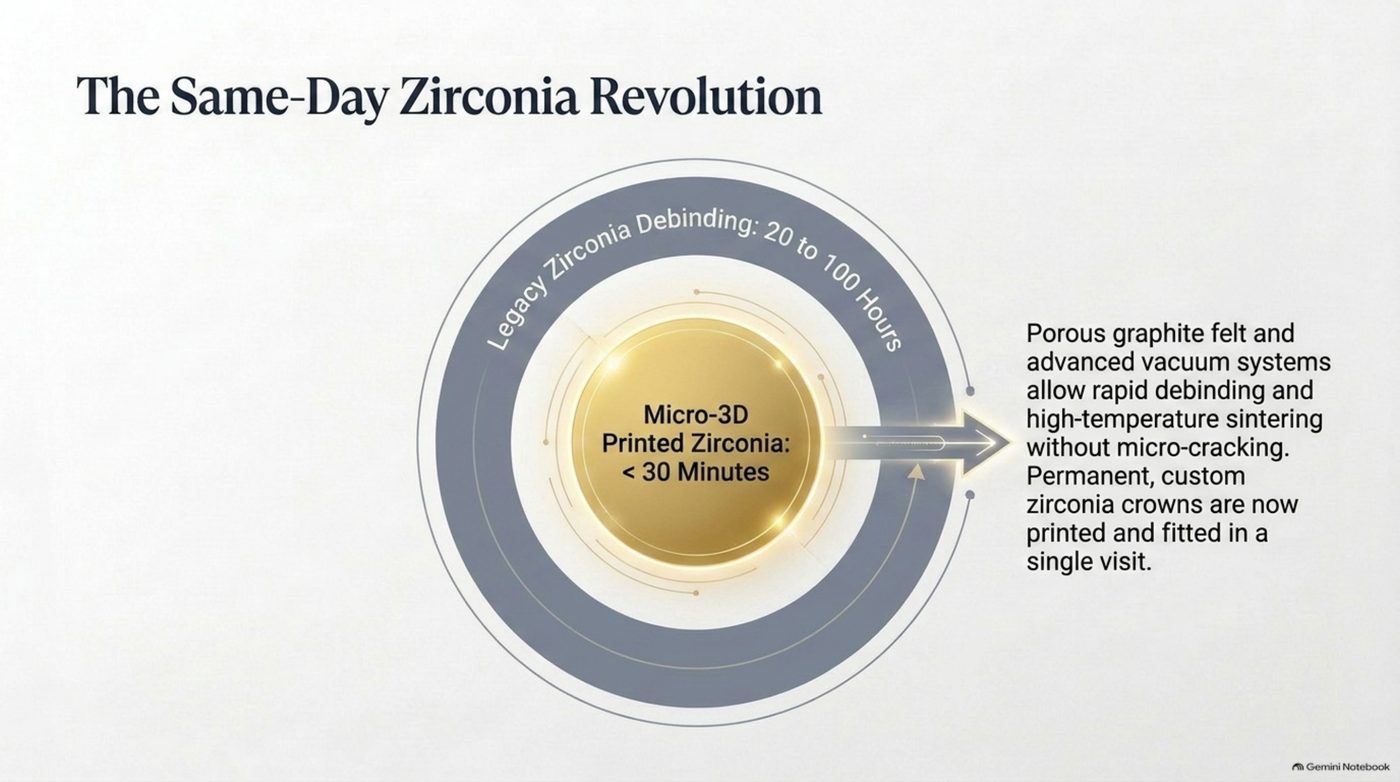
Zirconia has been the material of choice for strong, aesthetic crowns for years, and it has carried one persistent drawback: time. Sintering zirconia to full density is a high-temperature process, and doing it without introducing flaws has traditionally meant a considered, drawn-out cycle. The slide behind this article describes the change that removes that constraint. Micro-3D printed zirconia, in under 30 minutes. This is written for people around Sioux Falls, SD who are looking into cosmetic dental treatment and want the honest version rather than a sales page.
Why zirconia was slow
A zirconia restoration is not finished when it is shaped. The shaped piece is a porous, relatively weak form that must be debound and then sintered at high temperature to reach its final density and strength. The debinding and sintering stages are where quality is decided. Heat the piece too aggressively and you introduce micro-cracking: tiny internal flaws that do not show up on delivery and shorten the life of the restoration. Heat it carefully and the process takes time. For years that trade-off was simply accepted, and same-day zirconia meant working around it rather than solving it.
What changed: porous graphite felt and vacuum systems
Porous graphite felt and advanced vacuum systems allow rapid debinding and high-temperature sintering without micro-cracking. The materials and atmosphere do the work that a slow, gentle heating curve used to do, which is why the process can compress into minutes. The practical effect for a patient is that permanent, custom zirconia crowns can be printed and fitted in a single visit.
The workflow, side by side
| Workflow stage | Conventional zirconia | Micro-3D printed zirconia |
|---|---|---|
| Shaping | Milled from a blank, then finished | Micro-3D printed from the approved model |
| Debinding and sintering | Careful cycle, time-intensive, micro-crack risk | Rapid debinding and high-temperature sintering with porous graphite felt and advanced vacuum systems |
| Micro-cracking risk | Managed by slowing the cycle | Avoided without the slow cycle |
| Visits required | Restoration completed over a longer sequence | Printed and fitted in a single visit |
| Time to finished crown | Measured in days | Under 30 minutes |
What a single visit changes for you
One visit instead of several is not only a convenience argument. A restoration that is finished in the same appointment is fitted while everything relevant is in the room: the freshly captured geometry, the tested fit, the shade discussion, your own reaction to how it looks. Adjustments happen against the real thing rather than against a temporary. And a simpler path means fewer opportunities for the plan to drift between appointments.
A temporary is also a clinical compromise, however well made. It is a stand-in that the mouth is asked to tolerate while the real restoration is completed elsewhere. Removing that period removes a stage during which teeth can shift, margins can be disturbed, and the patient lives with something that is close but deliberately not final.
Is same-day zirconia the right choice for every case?
No, and it should not be presented as though it is. Material and method are chosen to fit the case — the tooth, the bite load it will carry, the aesthetic requirements of the surrounding teeth, and the available enamel. What has changed is that speed is no longer the reason to reject zirconia. The constraint that used to force a choice between a strong material and a same-day result has largely been removed.
To work out what a restoration like this would mean for your budget, start with the smile makeover cost guide and the veneer cost calculator, both free on the tools hub. To ask whether a same-day zirconia restoration suits your case, call (605) 601-8245.
Why the furnace is the hard part
Printing or milling the shape of a restoration is the visible half of the process and the easy half. A shaped zirconia piece is not yet strong; it reaches its final density only after debinding and sintering, and those stages are where a restoration is either made or quietly compromised. The difficulty is that the process needs heat and time to work, and rushing it introduces internal flaws that no one can see. Porous graphite felt and advanced vacuum systems change that equation by managing the atmosphere and the thermal environment, which is what allows the cycle to compress without damaging the piece.
What same-day actually refers to
Same-day means permanent, custom zirconia printed and fitted within a single visit, with print and sinter time measured at under 30 minutes. It does not mean every stage of a case is compressed. Diagnosis, mapping and planning still take the time they take, and they should. What has changed is that the interval between an approved plan and a finished, permanent restoration can now fit inside one appointment rather than spanning several.
Why the temporary disappears from the story
The temporary restoration existed because there was a gap to fill between preparing a tooth and receiving the finished piece. It was always a compromise: something the mouth accepted while the real restoration was made elsewhere. When the finished piece can be produced in the same visit, the gap closes and the compromise is no longer required. For the patient, that removes a phase of treatment rather than merely shortening it.
What the change means for your schedule
One visit instead of a sequence changes more than convenience. It removes the interval in which a temporary has to survive, and it removes the second impression or scan that a delayed fit can require. It also means the fit is assessed against the geometry captured for that same restoration, on the same day, by the same plan. For patients travelling in for treatment, or fitting appointments around work, the practical difference between a single visit and several is often the reason a restoration is scheduled at all.
Frequently Asked Questions
Is micro-3D printed zirconia as strong as conventionally sintered zirconia?
The goal of the process is to reach full density without introducing the micro-cracking that a rushed conventional cycle would cause. Avoiding those internal flaws is what protects the strength of the finished piece.
Can any crown really be made in a single visit?
Permanent, custom zirconia crowns can be printed and fitted in a single visit, in under 30 minutes of print-and-sinter time. Whether it applies to your specific tooth depends on the case’s requirements, which is a clinical decision rather than a scheduling one.
Why does micro-cracking matter so much?
Because it is invisible at delivery. A crown with internal micro-cracks looks correct on the day it is fitted and fails earlier than it should. Preventing it at fabrication is the only reliable way to deal with it.