By the time the plan reaches Step 4, it has been confirmed visually and captured digitally. The fabrication step is the moment the digital description becomes a physical object, and it is the point where traditional workflows quietly reintroduce the errors that the previous three steps removed. If you have been weighing up cosmetic dental treatment for a home around Sioux Falls, SD, this guide covers how it actually works, what it tends to cost, and where the results usually fall short.
The translation problem in traditional fabrication
Conventional lab work passes through many hands, and every pass is an opportunity for interpretation. A measurement is read and written down; the written note is used to shape something in wax; the wax form is invested, cast and finished. Each transition is a translation from one medium to another, and each one is performed by a person making a judgement. Over a single restoration the accumulated drift is usually small — which is exactly why it is so hard to argue with. The restoration is not obviously wrong. It is slightly off, in a way that shows up as a marginal gap rather than a visible defect.
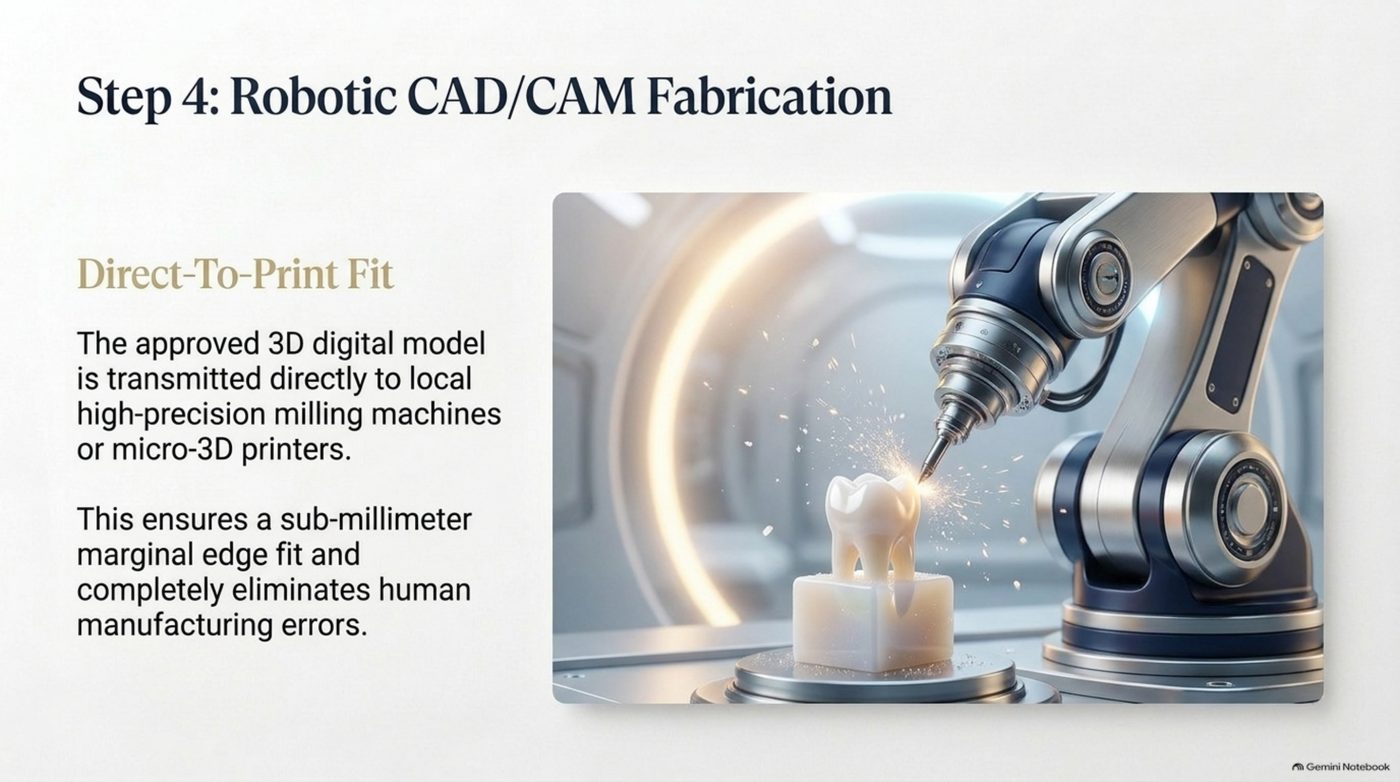
Direct-to-print fit
In the digital workflow, the approved 3D model is transmitted directly to high-precision milling machines or micro-3D printers. There is no intermediate hand shaping, no note to be misread, and no wax form standing between the design and the object. The deck's wording is precise: this ensures a sub-millimeter marginal edge fit and eliminates human manufacturing errors. The marginal edge is where the restoration meets the tooth, and it is the single most consequential dimension on the whole piece, because that is where bacteria enter, where staining begins, and where a restoration eventually fails.
Where precision is won and lost
| Fabrication stage | Manual-era variable | Digital and robotic control |
|---|---|---|
| Design handoff | Measurements transcribed by hand | Approved 3D model transmitted directly |
| Form making | Hand-shaped wax interpretation | Machined or micro-3D printed geometry |
| Marginal edge | Fitted and adjusted chairside by judgement | Sub-millimeter marginal edge fit built in |
| Error source | Human translation at each step | Human manufacturing errors eliminated |
| Reproducibility | Varies with the technician and the day | Repeats from the same model |
Why the marginal edge deserves its own paragraph
A sub-millimeter margin is not a vanity metric. When a restoration seats tightly, the seal at the tooth-restoration interface protects the underlying structure and resists the leakage that discolours a margin over time. When it does not seat tightly, everything downstream degrades faster: the adhesive is stressed, the margin collects stain, and the tooth underneath is exposed to the environment it was meant to be protected from. This is the mechanism by which a beautiful restoration becomes a disappointing one two years later, and it is why the roadmap treats the marginal fit as a headline deliverable rather than an internal detail.
What to ask about fabrication
Ask how the design leaves the planning stage: is it transmitted as a digital model, or re-measured by hand? Ask where the restoration is manufactured and by what process. And ask how the marginal fit is verified when the piece is seated. If the answers describe a single continuous digital chain from approved model to fitted restoration, you are looking at Step 4 done properly.
To estimate what a fabricated restoration means for your budget, run the veneer cost calculator and the smile makeover cost guide, both free on the tools hub. To discuss fabrication options for your own case, call (605) 601-8245.
Material and method follow the case
Fabrication technology is a means, not a decision in itself. Whether a given restoration is milled or micro-3D printed depends on the material, the load it has to carry, and the aesthetic demands of the teeth it sits beside. What Step 4 changes is not the clinical choice; it is the fidelity with which the chosen design is realised. A plan that survives to this stage intact is a plan that can be executed against measured geometry, and the manufacturing method is then selected to suit the case rather than the workflow.
Verifying the fit when the restoration arrives
The marginal fit delivered by the process still has to be confirmed in the mouth. The difference in a digital workflow is what that confirmation consists of. Instead of adjusting a piece that was approximated somewhere upstream, the clinician is checking a restoration built to the approved model, and any discrepancy can be referenced against the measurement it deviated from. That turns fitting from a process of judgement into a comparison, which is what makes it reproducible across cases and across days.
Why reproducibility is the real deliverable
Patients do not usually ask about reproducibility, and it is the property that matters most in the long run. A workflow that depends on one skilled pair of hands produces excellent results on good days and variable results on others. A workflow that carries an approved model from design to fabrication produces the same result repeatedly, because the variable steps have been removed rather than managed. That is what allows a plan to be promised to a patient with confidence rather than with hope.
The marginal edge as the long-term variable
Restorations rarely fail because the material gave way. They fail at the edge, where the restoration meets the tooth, and they fail through the seal at that edge rather than through the body of the piece. That is why a fabrication step that produces a sub-millimeter marginal edge fit is worth its complexity, and why an approximation in the same dimension is so costly. The difference between a tight margin and an almost-tight margin is invisible on the day of fitting and decisive several years later. Precision at this single dimension is the quiet reason the digital chain exists.
Frequently Asked Questions
Does robotic fabrication mean the restoration is designed by a machine?
No. The design is approved by you and your clinician; the machine executes that approved geometry. The point is to remove interpretation between the approved design and the finished object, not to remove the clinical judgement that produced it.
What does sub-millimeter marginal fit mean for how long a restoration lasts?
It means the seal at the tooth-restoration interface is as good as the process can make it, which is the foundation of longevity. Marginal leakage is one of the main ways cosmetic restorations age prematurely.
Is a milled restoration different from a printed one?
Both are produced from the same approved digital model. Milling and micro-3D printing are different manufacturing methods for the same geometry, and the choice between them depends on the material and the case.