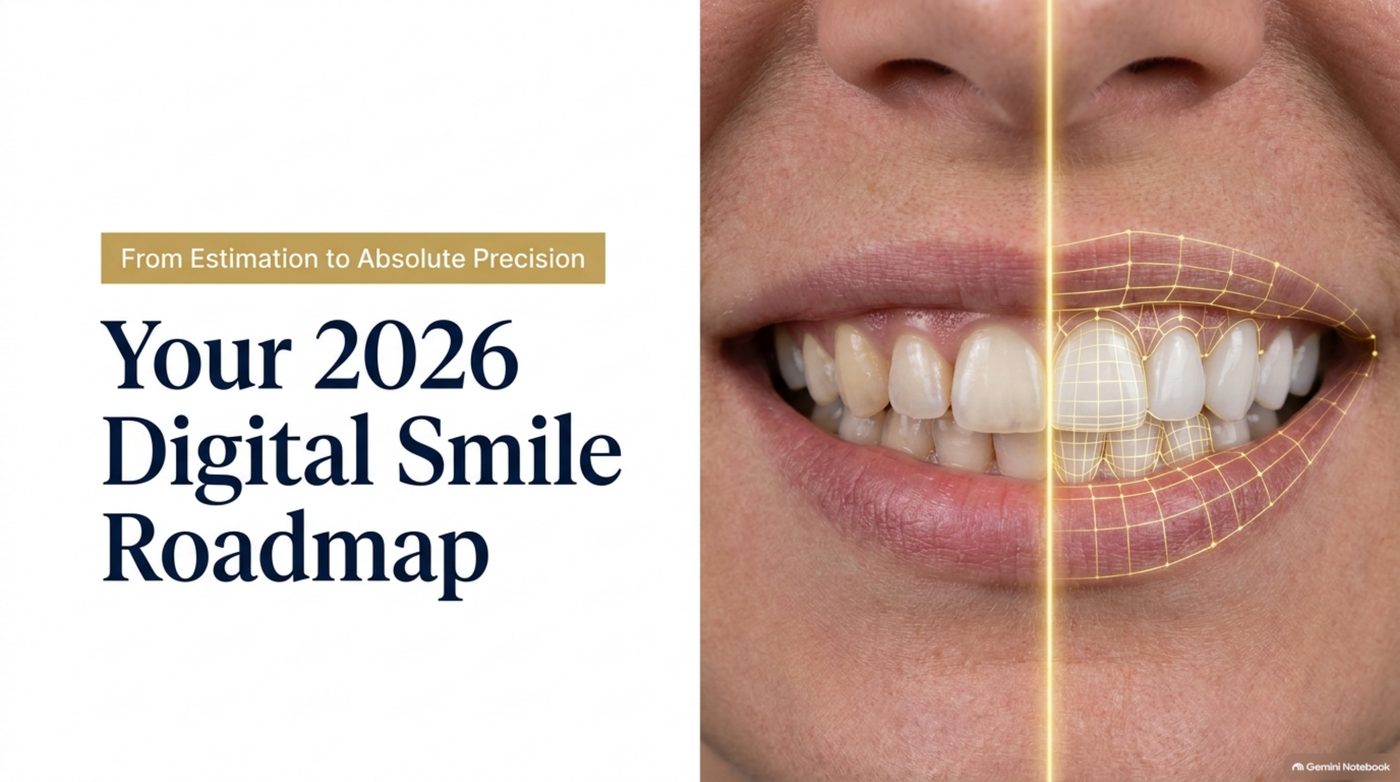
For most of the last thirty years, a smile makeover started with a conversation and ended with a guess. A dentist looked at your teeth, held a shade guide next to them, described a result in words, and then began removing tooth structure in the hope that the finished work matched what you had pictured. The 2026 Digital Smile Roadmap replaces that guess with a sequence of measurable, repeatable steps — a shift from estimation to absolute precision. Most people who read this are comparing cosmetic smile makeover options around Sioux Falls, SD, so what follows sticks to the details that change in practice.
This article is the entry point to that roadmap for patients in Sioux Falls, South Dakota. Each stage is covered in depth in its own guide, but before you read those, it helps to understand the whole arc: what changes, why it changes, and what you should expect to see and hear during a genuinely digital cosmetic consultation.
Why estimation was always the weak link
Estimation fails for a simple structural reason. When a plan lives only in a clinician's head and in a few two-dimensional X-rays, three kinds of error creep in. The first is diagnostic: early decay and bone changes are easy to miss when you are reading a flat image. The second is aesthetic: a patient's picture of the result and the dentist's picture of the result are two different pictures, and neither is visible until the work is finished. The third is manufacturing: every physical impression, pour, and hand-layered restoration introduces small translations from the original plan. None of these errors is dramatic on its own. Together they are the reason two patients can receive the same procedure and walk away with noticeably different results.
What "absolute precision" actually means
Precision is not a marketing word in this context. It means the plan, the simulation, the scan, and the manufactured restoration all describe the same object. The patient sees the outcome before treatment begins. The clinician sees hidden problems before a single tooth is prepared. The fabrication step receives the approved geometry directly, without a human reinterpreting it in between. When all four describe the same object, the only remaining variable is biology — and that is exactly the variable we want to spend our attention on.
The four steps, in order
The roadmap is deliberately sequential. Each stage constrains the next one, which is what keeps the plan coherent from first photograph to final fit.
| Roadmap step | What it replaces | What it delivers |
|---|---|---|
| Step 1 — Proactive risk planning | Reading flat X-rays for early problems | Interproximal caries detected, bone loss quantified, restorative margins verified |
| Step 2 — Visual confirmation | Describing a result in words | A preview of the exact aesthetic outcome from a single photograph |
| Step 3 — Precision mapping | Physical impressions and hand-measured notes | Millions of digital data points captured in seconds |
| Step 4 — Robotic fabrication | Hand-layered lab work with translation steps | A sub-millimeter marginal edge fit sent directly from the approved model |
The three things the roadmap is built to protect
Every stage in the deck serves one of three outcomes. Aesthetics is the visible one: ultra-thin, high-translucency restorations that mimic natural enamel instead of masking it. Preservation is the structural one: the move away from aggressive drilling and irreversible enamel loss, toward restorations measured in fractions of a millimeter. Predictability is the one patients feel most: software that accounts for your occlusion and protects your jaw joint before any physical work begins, so the smile you approve is the smile your bite can actually support.
Where to start before your first appointment
You do not need a referral to begin planning. Start with the free planning tools on this site: the smile quiz to clarify what you actually want to change, the smile makeover cost guide and veneer cost calculator to put numbers around it, and the knowledge quiz to test your assumptions. Browse the full tools hub if you are not sure which one fits. Then bring the results to a consultation — a roadmap works best when it starts from your own answers rather than from a treatment menu.
If you would rather talk it through first, call (605) 601-8245 and describe what you want to change. The rest of this series walks through each step of the 2026 roadmap in turn.
What the roadmap does not replace
It is worth being clear about the limits, because a roadmap presented without limits is really a sales pitch. The sequence does not replace clinical judgement — someone still has to decide which plan is right for your mouth, and no amount of data makes that decision automatic. It does not replace biology, and no planning process can promise how a particular body will heal. And it does not replace maintenance. What it does replace is the avoidable uncertainty: the problems that were visible in data and not looked for, the results that were imagined differently by two people, and the errors introduced when a plan changes hands.
What a genuinely digital consultation looks like
Expect to see things rather than hear them described. Expect your existing imaging to be examined for findings that are quantified rather than summarised. Expect a simulated outcome produced from your own photograph, and expect to be invited to react to it and change it. Expect questions about your bite, your jaw and your sleep, because those set the limits of what the smile design can do. If a consultation contains none of these, the plan being offered is an estimation plan wearing digital language.
The remaining articles in this series take each of the four steps in turn, then examine the evidence, the mechanics and the health-first sequencing that hold the roadmap together. Read them in any order — but the sequence in the deck is the order in which the plan is actually built.
Frequently Asked Questions
Is the 2026 Digital Smile Roadmap a single procedure?
No. It is a planning sequence that sits above whatever procedure you eventually choose. You can enter the roadmap for whitening, for veneers, or for a full smile makeover; the four steps are the same because they describe planning, simulation, capture, and fabrication rather than a specific treatment.
Do I need a digital consultation if I only want one tooth changed?
Single-tooth cases benefit as much as full-arch cases, and often more. Matching one restoration to the teeth beside it is a precision problem by definition, and the visual confirmation step is what prevents a repaired tooth from reading as obviously different in photographs.
What does "100% confidence in the outcome" mean in practice?
It means you approve a simulated result and a measured fit before the irreversible parts of treatment begin. You are not asked to trust a description. You are shown an outcome, and the plan that reaches it is the plan that gets fabricated.