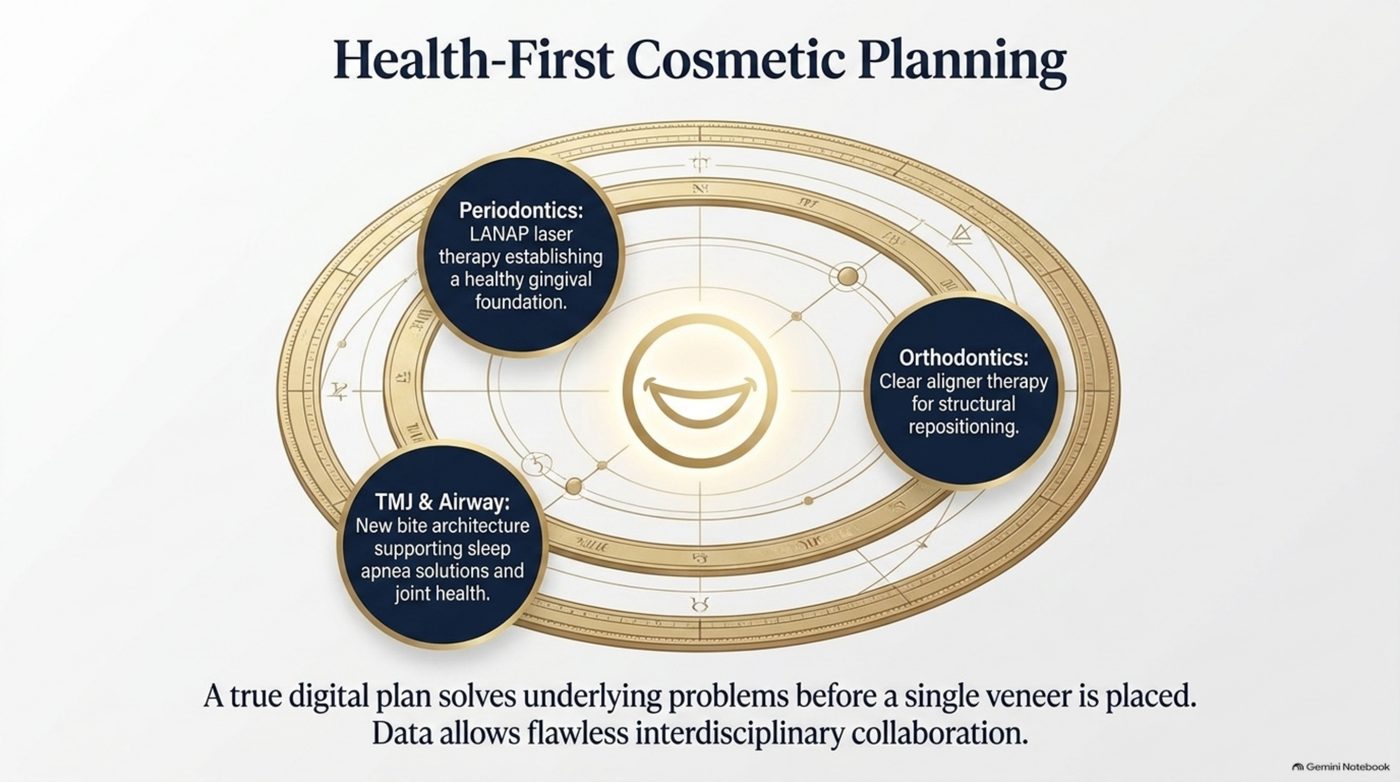
The most reliable predictor of whether a cosmetic result lasts is not the restoration. It is whether the conditions around the restoration were resolved first. The slide behind this article groups those conditions into three domains — periodontics, orthodontics, and TMJ and airway — and makes a claim that should be on the wall of every treatment room: a true digital plan solves underlying problems before a single veneer is placed. If you have been weighing up cosmetic dentistry questions for a home around Sioux Falls, SD, this guide covers how it actually works, what it tends to cost, and where the results usually fall short.
Periodontics: establishing a healthy gingival foundation
The gum tissue frames the smile, and healthy gums are not an aesthetic preference; they are the structural requirement underneath one. Laser therapy is named in the roadmap as the means of establishing a healthy gingival foundation. The logic of putting it first is worth spelling out: if the tissue is inflamed or unstable when restorations are placed, the tissue will change afterwards, and the margins will move with it. A restoration planned against a shifting foundation cannot stay precise, no matter how well it was fabricated.
Orthodontics: structural repositioning with clear aligner therapy
The second domain is position. Clear aligner therapy is used for structural repositioning, and its role in a cosmetic plan is easy to underestimate. If a tooth is rotated or out of position, a restoration covering it has to disguise the position rather than express it, which pushes the design toward thicker, more invasive work. Repositioning first often allows a thinner, more conservative restoration afterwards — the orthodontic stage pays for itself in preserved enamel.
TMJ and airway: the bite as architecture
The third domain is the one patients are least likely to raise and most likely to be affected by. A new bite architecture is described as supporting sleep apnea solutions and joint health. A smile is a system of surfaces that meet in a specific way, and changing those surfaces changes the forces your jaw joint experiences every time you close. Building the architecture first, rather than discovering it after the fact, is what prevents the classic outcome where the teeth look excellent and the jaw is unhappy.
How the three domains fit together
| Domain | What it resolves | Technology named in the roadmap | Why before cosmetics |
|---|---|---|---|
| Periodontics | Gingival health and stability | Laser therapy | Margins planned against a stable foundation do not move afterwards |
| Orthodontics | Structural position of the teeth | Clear aligner therapy | Correct position supports thinner, less invasive restorations |
| TMJ & airway | Bite architecture, joint health, sleep apnea | New bite architecture | Forces the jaw joint experiences are designed rather than discovered |
Why data makes this collaboration possible
The roadmap adds a second point that is easy to skip: data allows flawless interdisciplinary collaboration. Health-first planning is inherently a multi-specialist activity, and specialists work well together only when they are looking at the same model. When the periodontal findings, the alignment plan and the bite architecture all describe one digital object, each discipline can work on its own part without invalidating the others. When each holds its own paper record, the plan drifts between them.
The periodontal vet checklist and the bite force quiz are both free on the tools hub, and each gives you a concrete starting point for one of these domains. To have all three assessed in one place, call (605) 601-8245.
Sequencing across disciplines
Health-first planning is genuinely a sequencing problem, and getting the order wrong wastes work. Tissue health has to come before margins, because margins planned against unstable tissue will move. Position has to come before shape, because a restoration designed to disguise a rotated tooth is thicker and more invasive than one designed for a tooth already in place. Bite architecture has to come before the aesthetic finish, because the finish has to be built to survive the forces that architecture produces. The order is not a preference; each step changes the constraints the next one works within.
What health-first means for the timeline
Patients sometimes hear "health-first" and expect a longer process, and honesty requires acknowledging that it can be. Treating a periodontal condition or completing a course of aligner therapy takes time, and trying to compress it would defeat the purpose. The trade is a straightforward one: a longer sequence with stable conditions underneath, or a shorter sequence whose result may need revisiting because the foundation shifted. The roadmap's position is that the first is the better bargain, and the survival evidence in this series supports that reading.
Why one digital record makes the collaboration work
Multidisciplinary planning fails for a mundane reason more often than a clinical one. Each specialist works from their own record, and the records disagree in small ways that compound. A periodontal measurement, an alignment plan and a bite assessment that all describe one digital object cannot disagree, because they are the same object described from different angles. That is the practical value of the closed loop described later in this series: it allows separate disciplines to work on one plan rather than on several similar plans.
What health-first planning asks of you
It asks you to accept that some stages take time and cannot be compressed without losing their purpose. It asks you to disclose things a cosmetic consultation does not usually cover: jaw discomfort, breathing during sleep, habits that load the teeth. And it asks you to treat the smile as the last stage of a sequence rather than the first. In exchange, the result is planned against conditions that will still be there in five years, rather than against conditions that happen to be present on the day the restorations are bonded. That is the whole bargain of health-first cosmetic planning.
Frequently Asked Questions
Do I need gum treatment before veneers?
Not always, but it has to be checked rather than assumed. Tissue that is not stable when restorations are placed will change afterwards, and the margins will change with it.
Can aligners and veneers be planned together?
They are frequently planned in sequence, with alignment addressing position so that the restorative stage can be more conservative. The order matters because each stage changes what the next one can achieve.
Why does a cosmetic consultation ask about sleep and jaw pain?
Because the bite architecture you already have may not be the one your new smile needs. Asking early means the plan can address it deliberately instead of running into it later.