The individual steps of the 2026 Digital Smile Roadmap are useful on their own, but the reason they add up to something more is that they form a loop. The slide behind this article draws it explicitly: findings constrain the simulation, the simulation dictates the scan parameters, the scan geometry drives fabrication, and the manufactured result can be checked against the plan that produced it. Feedback that would normally appear too late arrives in time to act on. If you are here looking into cosmetic dentistry questions, the sections below walk through the process from the first quote to the finished job.
Reading the loop in order
The loop has five stations, and each one passes something specific to the next.
| Loop stage | What it receives | What it passes on |
|---|---|---|
| AI diagnosis | Imaging and quantified clinical findings | Findings that constrain the simulation |
| SmileViz simulation | A photograph plus the diagnostic constraints | An approved visual outcome |
| 3D scan | Parameters dictated by the simulation | Millions of measured data points |
| CAD/CAM | Scan geometry | Fabrication instructions for the approved model |
| The approved model | A fabricated result with zero data degradation |
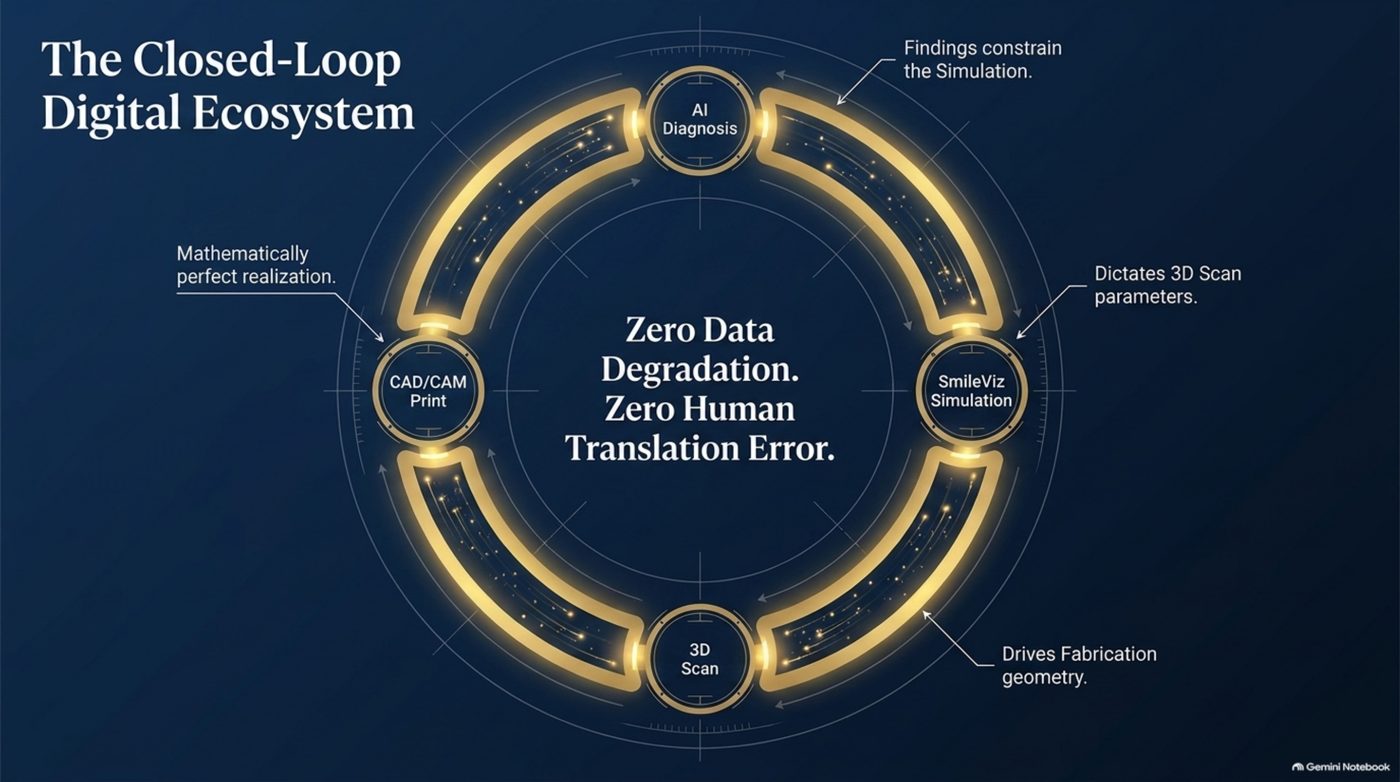
Findings constrain the simulation
The loop starts where Step 1 finished. When the diagnostic stage has quantified bone levels and verified margins, those numbers are not a separate report filed alongside the smile design — they are inputs to it. A simulation that ignores the foundation produces an outcome that looks achievable and is not. Constraining the simulation with findings is what makes the preview trustworthy rather than aspirational.
The simulation dictates the scan parameters
This is the least obvious link and the one that most distinguishes a loop from a sequence. In a linear workflow, scanning is a standard capture performed before anyone knows what the case needs. In a loop, the approved simulation tells the capture stage what resolution and which landmarks matter, so the scan is collected with a purpose rather than in the hope that it will be sufficient. Capture done to specification is what makes the next station possible.
Scan drives fabrication geometry
The captured geometry drives the fabrication. Because the scan was taken to the simulation's specification and the simulation was built within the diagnostic constraints, the geometry that reaches the machine already expresses the decisions that were made at every prior station. Nothing needs to be re-decided at fabrication time, which is the point at which re-decisions usually become expensive.
Mathematically perfect realisation, and the two zeros
The loop closes with two claims: zero data degradation and zero human translation error. Both describe the same property from different angles. Data degradation is the loss that happens when a plan is copied from one medium to another — a measurement written down, a form transferred, a cast poured. Human translation error is the interpretation that happens whenever a person re-reads a plan and acts on their understanding of it. A closed loop removes both by keeping one digital object moving forward, which is why the deck can describe the outcome as mathematically perfect realisation rather than approximate reproduction.
To see where you currently sit in this loop, the smart diagnostic quiz and the cosmetic dentistry knowledge quiz are both free on the tools hub. To walk the loop for your own case, call (605) 601-8245.
What breaks a loop
A loop has an obvious failure mode: any single link that stops passing information forward breaks the chain, and the later stations receive less than they were designed to work with. In practice, loops break at the points where a digital step hands off to a person who re-records what they were given. A measurement written onto a form, a model poured from an impression, a design re-measured at the bench — each is a break, and each one replaces a transmission with an interpretation. The two claims the deck makes, zero data degradation and zero human translation error, are best understood as descriptions of a loop with no breaks in it.
Why each station has to be able to receive what it needs
A loop is only as strong as the compatibility between adjacent stations. The simulation can only constrain the scan if it can express what it wants measured. The scan can only drive fabrication if the captured geometry is in a form the machine can use. This is why the roadmap treats the sequence as a single system rather than four separate services: the value does not come from owning any one of the technologies, it comes from each one being able to hand the next a complete and unambiguous version of the plan.
The patient's place in the ecosystem
The loop contains one step that is not technological, and it is the one without which the rest are pointless. The visual confirmation is where a technically coherent plan becomes a plan the patient has agreed to. Everything downstream — the scan parameters, the fabrication geometry, the marginal fit — executes the outcome that was approved at that moment. That is why the confirmation sits inside the loop rather than at the end of it. A loop that executes a plan nobody agreed to is just a very precise way of producing the wrong result.
What the loop means for the patient
The practical benefit of a closed loop is that the plan you approve is the plan that gets built. You are not approving a description that will be reinterpreted at three later stages by people who never saw the conversation. You are approving a digital object that travels to fabrication without being rewritten. That is a small claim with large consequences: it means the thing you looked at in the chair is the thing that arrives at the end, which is what makes the visual confirmation worth taking seriously in the first place.
Frequently Asked Questions
What does zero data degradation actually mean?
It means the geometry approved at the planning stage is the geometry that reaches fabrication, without being re-recorded or approximated at any point in between. Nothing is lost in translation because nothing is translated.
Is this the same as digital smile design?
Digital smile design is one station in the loop. The ecosystem adds the diagnostic constraints upstream and the fabrication link downstream, so the design is not a standalone picture but part of a continuous chain.
Why does the loop need a patient-facing step at all?
Because the loop depends on an approved outcome. The visual confirmation is what converts a technically valid plan into a plan the patient has actually agreed to, which is what the whole chain then executes.