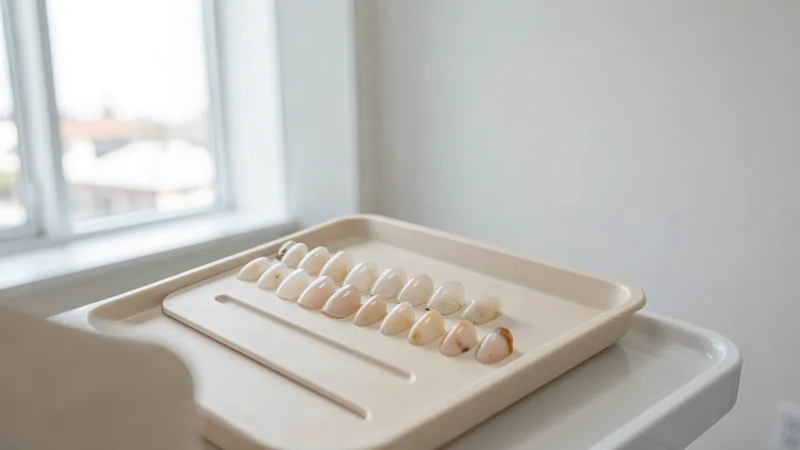
The aesthetic standard that dominated cosmetic dentistry for two decades was built on opacity. Opaque, bright, uniform — blocky white restorations that read as obviously manufactured. They were achievable, they were dramatic, and they demanded a price: a large fraction of your enamel, removed permanently, plus a bite engineered around volume rather than around your natural occlusion. The biomimetic era reverses all three of those priorities. Most people who read this are comparing cosmetic smile makeover options around Sioux Falls, SD, so what follows sticks to the details that change in practice.
The three columns of the shift
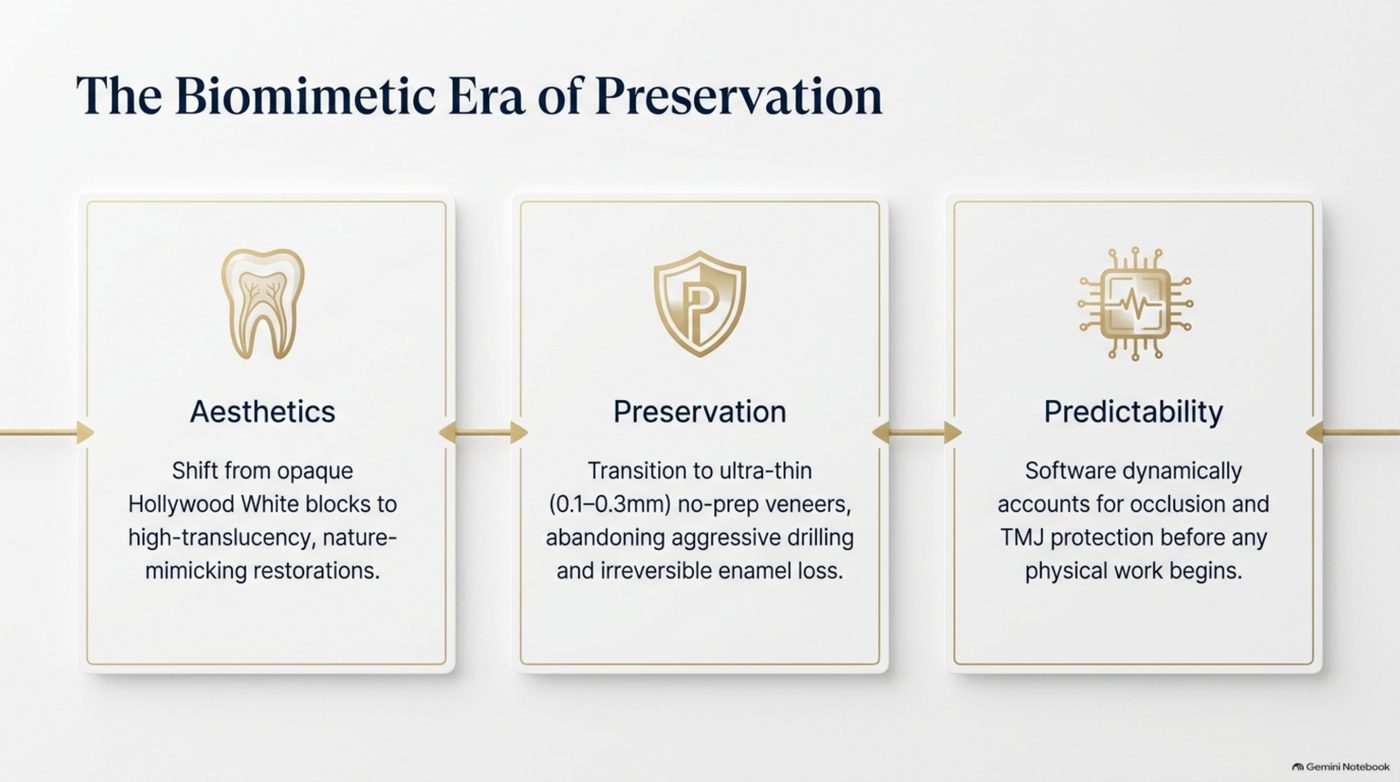
The slide behind this article lays the change out as three parallel shifts, and it is worth reading them as one movement rather than three separate trends.
Aesthetics: from opaque blocks to nature-mimicking restorations
The move is toward high-translucency, nature-mimicking restorations. Instead of a uniform white surface, the goal is a restoration that transmits light the way enamel does — because the eye reads translucency, not whiteness, as natural. A bright tooth that blocks light looks artificial even from across a room; a slightly less white tooth that lets light through reads as alive.
Preservation: from aggressive drilling to 0.1–0.3mm restorations
The second shift is the one with permanent consequences. Older protocols removed tooth structure in millimeter-scale slices. The current generation of ultra-thin veneers sits between 0.1mm and 0.3mm — thin enough that preparation is often minimal or unnecessary, which is why the approach is called no-prep. Enamel that is not removed cannot be replaced, and the whole point of preservation is to still own that enamel in twenty years.
Predictability: software that accounts for occlusion and TMJ first
The third shift is invisible but decisive. Before any physical work begins, planning software accounts for your occlusion and protects your jaw joint. Aesthetic work that ignores the bite is how patients end up with a beautiful smile they cannot comfortably close. Building the bite into the simulation first is what makes the aesthetic result stable instead of merely photographic.
What actually changed between the two eras
| Dimension | The opaque 'Hollywood white' era | The biomimetic era |
|---|---|---|
| Restoration thickness | Millimeter-scale, volume-driven | 0.1–0.3mm ultra-thin, enamel-sparing |
| Tooth structure removed | Substantial, often irreversible | Minimal to none (no-prep protocols) |
| Surface appearance | Opaque and uniformly white | High-translucency, nature-mimicking |
| When the bite is planned | After the aesthetic shape is set | Before any physical work begins (occlusion and TMJ) |
| Patient's own enamel | Frequently sacrificed | Preserved as the foundation |
Why preservation is not the same as compromise
There is a persistent assumption that removing less tooth structure means accepting a weaker result. The clinical evidence in this series points the other way. When a restoration is bonded directly to untouched or minimally prepared enamel, the enamel and the restoration behave as a unified structure rather than as a shell sitting on a reduced tooth. The slides in this deck put the long-term survival comparison side by side, and the enamel-preserving protocol is not the one that loses.
How to tell whether you are being offered the biomimetic approach
Ask three questions at your consultation. How much tooth structure will be removed, and in what units? What is the planned thickness of the restoration? And when in the process is my bite assessed? If the answers involve millimeters of reduction, millimeter-scale thickness, and a bite assessment that happens before the aesthetic design is finalised, you are being planned in the biomimetic era. If the answers are vague, you are still being planned by estimation.
To sanity-check a quote before you commit, run the numbers through the veneer cost calculator and test your own assumptions with the cosmetic dentistry knowledge quiz. The full set of planning tools lives on the tools hub. Questions about what your own teeth can support? Call (605) 601-8245.
Where occlusion fits into the design
Occlusion is the way your upper and lower teeth meet, and it is the reason software has to be part of this era rather than an optional add-on. A restoration designed purely for appearance can add volume exactly where the bite cannot accommodate it. The measured consequence is not a cosmetic one: the patient ends up with teeth that meet earlier on one side than the other, and the jaw compensates. Building the occlusion in first, then designing within it, is how the biomimetic approach avoids producing a beautiful set of teeth that the joint resents.
The maintenance question
Preserving enamel changes maintenance rather than removing it. Ultra-thin restorations that bond to enamel are thin, and thin restorations depend on a clean margin and a stable supporting tissue. That makes gum health the practical foundation of the whole approach: inflamed or receding tissue changes the margin a restoration was bonded to, and a changed margin is where a thin restoration starts to fail. The health-first planning described elsewhere in this series is not a separate topic from preservation. It is the condition that makes preservation hold.
It also means the questions worth asking at the end of treatment are the same ones worth asking at the start. What is the thickness of what was placed? How much of my enamel remains? When will the bite be reassessed? A patient who can answer those questions is in a position to protect the result, rather than simply hope that it holds.
The questions that define the era
Three questions separate the biomimetic era from the one before it. How much tooth structure is removed, and in what units? What is the thickness of the restoration being placed? And is my bite assessed before or after the aesthetic design is fixed? The answers matter more than the vocabulary a practice uses. A plan built on 0.1–0.3mm restorations, minimal preparation and a bite assessed first is biomimetic in the sense that counts. The rest is description.
Frequently Asked Questions
Are 0.1–0.3mm veneers strong enough to last?
Thin restorations are not fragile restorations. When ultra-thin porcelain is bonded to enamel, the two form a unified structure that absorbs chewing forces, and the preservation of the underlying enamel is precisely what protects the long-term prognosis.
Does no-prep mean nothing is done to my teeth at all?
It means preparation is minimal or unnecessary rather than automatic. The exact figure depends on your starting shape and position, which is why the roadmap assesses your bite and your enamel before committing to any thickness.
Why does the bite get planned before the smile design?
Because occlusion sets the limits of what your jaw joint can comfortably support. Planning the bite first means the aesthetic result you approve is a result your mouth can actually live with every day.