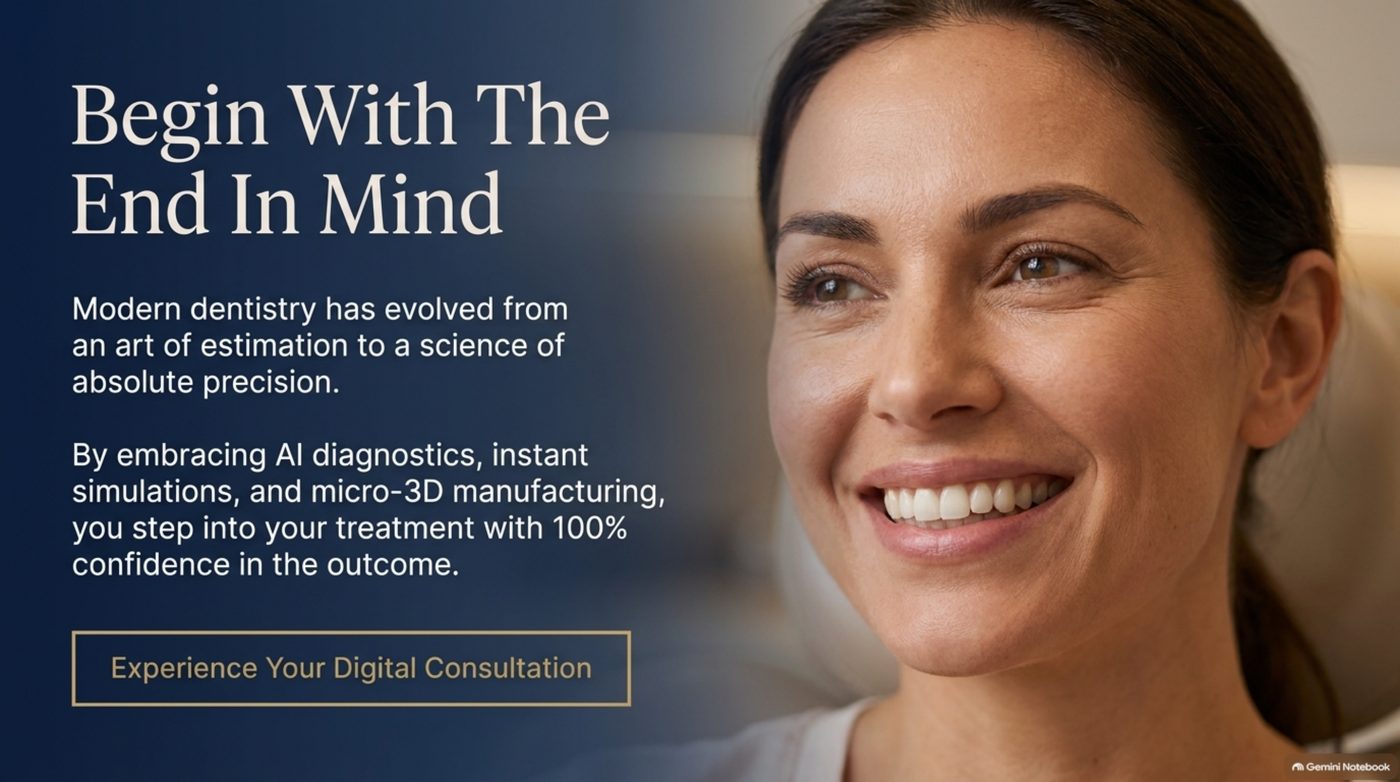
The closing slide of the 2026 Digital Smile Roadmap makes the summary claim of the whole deck: modern dentistry has evolved from an art of estimation to a science of absolute precision. Everything before this point in the series has been a step. This article is about what the steps add up to, and what you should expect when you sit down for a digital consultation in Sioux Falls.
Estimation to precision, stated plainly
Estimation is a plan held in a clinician's judgement and communicated in words. Precision is a plan held in a digital object and communicated as an outcome you can look at. The difference is not that judgement has become unnecessary — it has not, and clinical judgement is what decides which plan is appropriate. The difference is that judgement now operates on measured data and produces a checkable result, rather than operating on impressions and producing a result that can only be assessed after it is irreversible.
The three capabilities that make it work
The deck names the three capabilities explicitly: AI diagnostics, instant simulations, and micro-3D manufacturing. Each one removes a specific category of uncertainty.
AI diagnostics remove the missed-problem category
Hidden decay, unquantified bone loss and unverified margins are the three findings covered in Step 1. Each is the kind of problem that ruins an otherwise sound cosmetic plan when it surfaces later. Looking for them first, with tools that measure rather than describe, removes that category from the list of things that can go wrong.
Instant simulation removes the wrong-picture category
The mismatch between what you pictured and what a clinician described is the most human of the failure modes, and the cheapest to fix. When a visual confirmation is available in minutes from a single photograph, approving a description is no longer necessary.
Micro-3D manufacturing removes the translation category
Every hand transfer between design and object is a chance for the result to drift. Transmitting the approved model directly to fabrication, and holding a sub-millimeter marginal edge fit as the standard, removes that drift from the process.
What the steps give you, measured
| Capability | Before treatment | What you can expect |
|---|---|---|
| AI diagnostics | Problems found after work is placed | Hidden findings surfaced before the plan is fixed |
| Instant simulation | A description to approve | Your future smile shown before you commit to a single procedure |
| Micro-3D manufacturing | Fit adjusted chairside by judgement | A sub-millimeter marginal edge fit from the approved model |
| Precision mapping | Physical impressions and hand notes | Millions of data points captured in seconds |
| Same-day zirconia | Restoration completed over a longer sequence | Printed and fitted in a single visit, in under 30 minutes |
Confidence in the outcome, defined
The slide's promise is that you step into your treatment with 100% confidence in the outcome. Read that as a definition rather than a slogan. Confidence means you have seen the result you are buying, you have had the foundation beneath it checked, and you know the restoration will be made from the model you approved. It does not mean biological outcomes are guaranteed — nothing in medicine means that. It means the parts of the outcome that planning can control have been planned, in order, with data.
How to begin
Begin with what you want to change. The smile quiz turns a general wish into a specific list, the smile makeover cost guide and veneer cost calculator put numbers around it, and the knowledge quiz separates what you have read from what is true of your case. Every tool is free on the tools hub, and each one gives you something concrete to bring to a consultation.
Then have the conversation. Describe your goal, ask how much tooth structure would be removed, ask when your bite will be assessed, and ask to see a simulated outcome before anything irreversible happens. If you would like to start that conversation now, call (605) 601-8245.
What to bring to a digital consultation
The most useful thing you can bring is a clear statement of what you want to change, which is harder to produce than it sounds. Most patients arrive with a general wish — whiter, straighter, less worn — and a consultation works better when that wish has been turned into specifics. The smile quiz is designed for exactly that, and the bite force quiz adds something most patients never think to consider: how the forces in your mouth are currently distributed. Bring recent imaging if you have it, bring any photographs that show what you mean, and bring your questions about cost. None of that is required, and all of it makes the first appointment more productive.
Questions that reveal a precision plan
Ask how much tooth structure would be removed, and ask for the answer in units. Ask what the planned thickness of any restoration would be. Ask when your bite architecture will be assessed and by what method. Ask to see a simulated outcome before anything irreversible is agreed. A plan built in the sequence described across this series can answer all four without hesitation, because each answer is a measurement it already holds. If the answers are approximate, you are looking at estimation, and the whole point of the 2026 roadmap is that estimation is no longer necessary.
Frequently Asked Questions
What is a digital consultation?
It is an appointment where diagnosis, simulation, capture and fabrication planning are handled as one connected sequence rather than as separate referrals. You leave with a plan expressed as a measured, visual outcome rather than a description.
Do I need to complete every step before deciding?
You decide after the visual confirmation, before any irreversible work. The diagnostic and simulation steps exist so that decision is made with evidence in front of you rather than in its absence.
Is this approach more expensive than a traditional plan?
The planning sequence is not a treatment in itself, and the preservation it supports can reduce what is done to your teeth over time. For a sense of what treatment would cost in Sioux Falls, start with the cost guide and calculator on the tools hub.